Showing posts with label Copenhagen. Show all posts

Thursday, July 25, 2013

Day 46. Architecture, Part 4: Free rein.

I went with my coworkers to Ørestad, a neighborhood in Vestamager that has seen a recent boom in ambitious and wildly designed buildings. Up-and-coming designers like Bjarke Ingels (<<website is awesome) have been given relatively free rein to dream up and construct living spaces and office buildings that Europe often shies away from, a result of strict zoning that prevents bold new architecture from mingling with quaint old architecture.

With tons of open land and license to experiment, architects have bent glass and steel into crazy apartment blocks like 8TALLET and the Tietgen Students' Residence. Honestly, the trip to Ørestad felt a bit like a trip into Orbit City - all that was missing was a Spacely Sprockets factory.

Inside 8TALLET

Ørestad Plejecenter: the coolest nursing home on the planet?

Wednesday, July 24, 2013

Day 45. Architecture, Part 3: Cultural buildings.

This is part three of four. My architectural knowledge is sorely lacking, and you're probably over it with the buildings.

Like any good European city, Copenhagen has its fair share of public cultural spaces, including art museums, libraries and concert halls. The most grand is the Operaen, the Opera House, financed by the family behind Mærsk, Denmark's most powerful corporation. Built at a cost of over $500 million, the Operahuset København is imposing and flashy in its place along the main harbor. It's just one of the many striking cultural spaces scattered around the capital. The Royal Library's new extension, nicknamed Den Sorte Diamant (the Black Diamond), is another.

Operahuset København
(thanks, Jefferson, for these pics)

Det Kongeliget Bibliotek (The Royal Library), a.k.a. Den Sorte Diamant (The Black Diamond)

Tuesday, July 23, 2013

Day 44. Architecture, Part 2: Churches.

The grand cathedrals of Europe often marked the dawning or even the apex of a particular architectural era. Notre Dame de Paris is a temple to the gothic, Rome's Church of the Gesù to the Baroque, Imperial Russia's Smolny Cathedral to the Rococo. Churches are simply the best indicators of architectural standards before, say, World War I, because money and talent flowed to these projects.

The same can be said for the churches of Denmark. I've already included a few churches, including one from Amager, a traditional stave church and Grundtvigs Kirke, all of which have unique character. Even when conforming to period-specific architectural forms, the Danes made their churches distinctly Danish.

The corkscrew spire of Vor Frelsers Kirke, Copenhagen, Baroque
St. Albans Kirke, Odense, Neogothic

Monday, July 22, 2013

Day 43. Architecture, Part 1: Row houses.


Modern apartment blocks dominate much of "new" Copenhagen, especially the district of Vestamager and along the main harbor. Glass and steel are the materials of choice for Denmark's current batch of architects, and the buildings they design are incredibly imaginative. I'll write about these soon.

Conversely, most of "old" Copenhagen (especially Indre By, where I live), is a charming mishmash of row houses that crowd the streets and sidewalks below. They're filled with character, slanting and spilling toward each other, and yet they're very often expensive to purchase or rent. Never do two adjacent match in color and rarely do they match in size or detail.

This is the Copenhagen tourists love.


Sunday, July 21, 2013

Day 42. Sommerferie.

The average Dane takes five to six weeks of vacation a year. Most take half or more of that time off in the summer. My drycleaner is but one of the small businesses - restaurants, salons and bakeries, too - that decide to simply close their doors for sommerferie, summer holiday.


Thursday, July 18, 2013

Day 39. Skyline.

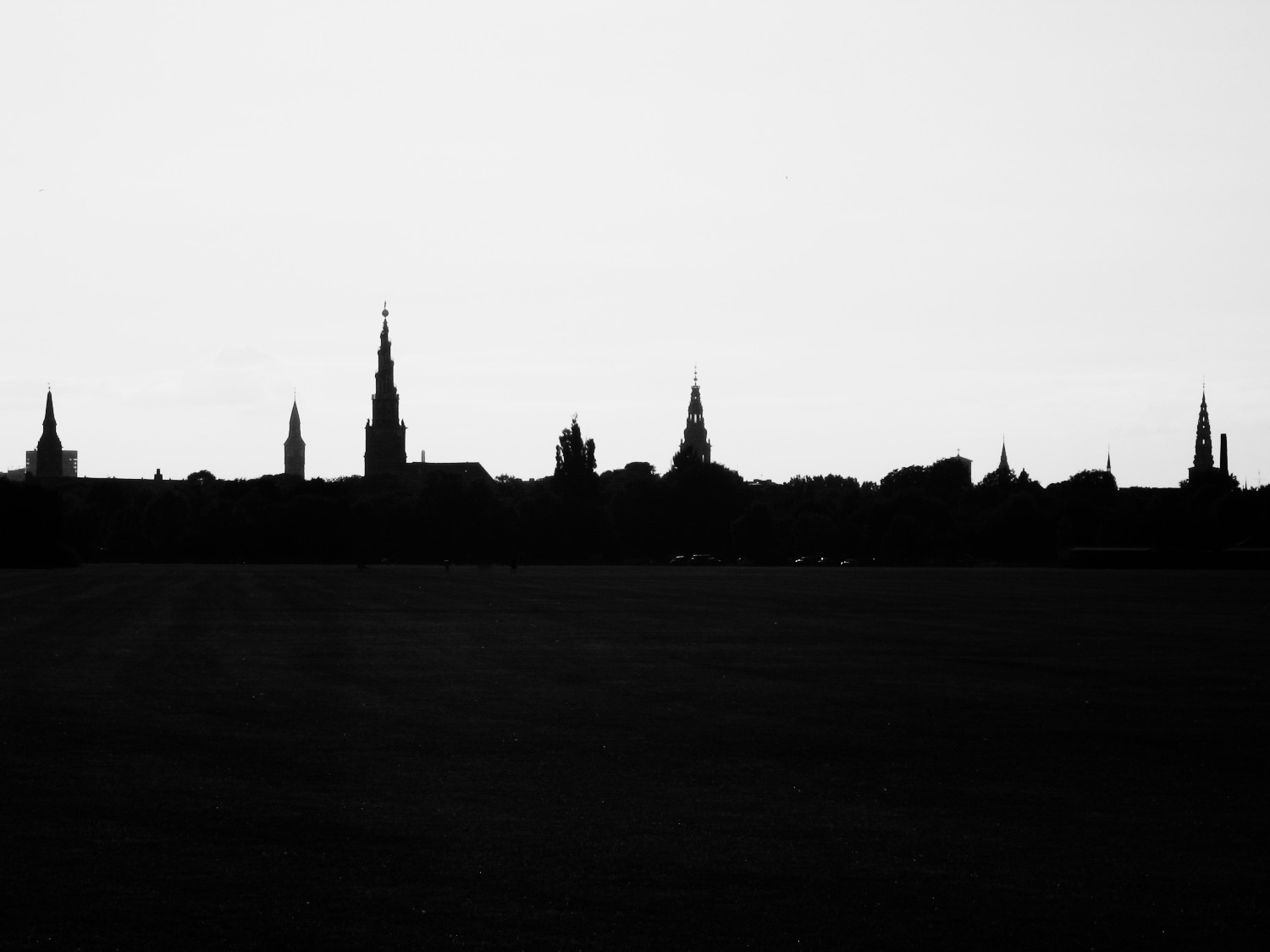
It's rarely hazy in Copenhagen. Strong winds blow straight across the North Sea and meet little resistance passing over the flat, open lands of Denmark. Yesterday, however, the wind died down as I was biking from the southeastern part of Copenhagen back toward downtown. I stopped and faced the city. With the sun hanging behind and the air above it fuzzy, the famous spire-filled skyline was drained of most of its color. I drained it only a bit more for the silhouette.

The tallest of these spires the famous spiral tower of Vor Frelsers Kirke. Immediately to its left is Rådhus (City Hall).

Wednesday, July 17, 2013

Day 38. Crow-steps.

Across Europe - but particularly in Scandinavia and the Netherlands - crow-step gables are a popular architectural detail. The design is most commonly found on churches, from the small one from Amager pictured below to the big ones like Grundtvigs Kirke and Roskilde Cathedral. It's a subtle quirk that adds a lot of character to these otherwise stark buildings, and I love spotting them throughout the city.

Tuesday, July 16, 2013

Day 37. Wind.

If one were to boil down the Danish economy into its four most profitable exports, it'd look something like this:
Since I'm probably not allowed in Novo Nordisk's laboratories with a camera, and I'd rather not visit a slaughterhouse or an oil rig, you get to read about wind energy. Vestas, based in Aarhus, is the world's largest producer of wind turbines and one of the country's largest corporations. Given the nation's love for all things eco-friendly, the company's footprint is everywhere in – and around – Denmark.


(Legos, incidentally, would be number eight on that list.)

Sunday, July 14, 2013

Day 35. Hygge.

Growing up in Milwaukee, I'd often see references to Gemütlichkeit. It's one of those great German words that is somehow both long and concise. Gemütlichkeit, according to Wikipedia, means "a situation that induces a cheerful mood, peace of mind, with connotation of belonging and social acceptance, coziness and unhurry."

The Danes have something similar, and they're quite proud of it: hygge. Like 
Gemütlichkeit, hygge is a sort of state of relaxed and cheerful peace found in the company of good friends and family. There's evidence of it everywhere in Copenhagen: picnics, open-air jazz concerts, families relaxing in a park, and friends sharing a beer or a long meal. Sometimes, it's as simple as joining your buddies and watching boats pass by.


Friday, July 12, 2013

Day 33. Taxis.

A picture like the one below would come as no surprise to anybody who has visited Germany or much of Central or Northern Europe.

One hears a lot of sayings like, "You can tell a lot about a man by the shoes he wears," and so forth. I think one could derive similar inferences about nations from their Mercedes/BMW taxis. In Denmark's case, it would be expensive, exceptionally clean and detail-obsessed.


Wednesday, July 10, 2013

Days 30 and 31. Half-timbers.

Though they're more common in smaller towns, Danish half-timbered buildings do still exist in Copenhagen. Spotting one in the middle of a modern city, with cars and buses buzzing past, always reminds me of when somebody superimposes an old photograph on a present day scene. Spatially, the buildings fit, but they're entirely anachronistic with their sagging frames and bright colors.

central Copenhagen

Odense

near Christianshavn, Copenhagen

Monday, July 8, 2013

Day 29. Rosenborg again.

I keep coming back to the Rosenborg Castle grounds. Yes, the castle itself is beautiful, the lawns are perfect, and the gardens are striking. What stands out, though, is how consistently peaceful it is despite the fact that it's always filled with people.


Sunday, July 7, 2013

Day 28. Jazz.

Copenhagen loves jazz. It's like the forgotten, cold-weather, European cousin of the Mississippi Delta... except with socialized medicine and such. Louis Armstrong visited, recorded and played live (amazing video in that link, by the way). So did Thelonious Monk, Dizzy Gillespie and the Giants of Jazz. Dexter Gordon made CPH his second home. Jazzhus Montmartre is the closest thing, east of Paris, that you'll find to the legendary jazz clubs of Harlem.

Every July, the city itself becomes festival grounds, and jazz musicians pop up in parks, in city squares, in courtyards, at music halls, along canals and in cafés. The Copenhagen Jazz Festival began Friday, and bands from near and far descended upon the town. Already I've run into multiple shows that seem to have sprouted up spontaneously and attracted a steady swarm of onlookers.

There's a jazz band under that bridge.  I promise.

Thursday, July 4, 2013

Day 25. Uafhængighedsdag.

Today there were no morning parades, no afternoon barbecues, no nighttime fireworks. Still, I felt my patriotic obligation to do something at least semi-American on Independence Day -- or Uafhængighedsdag in Danish. Around noon, I made a pilgrimage to the FDR memorial statue, which sits on a leafy boulevard along Sankt Annes Plads.

The bronze disembodied head of Mr. Roosevelt is, to my knowledge, the only statue of an American in Copenhagen (Randers, in the west, has an entire Elvis Presley museum). That FDR would have this singular honor makes sense. In 1940, the Nazis marched north into Denmark, quickly establishing a puppet government and planning an attack on the far more strategically-valuable Norway. Though the occupation was relatively bloodless, the Germans nonetheless tossed Danish sovereignty aside. 

Denmark therefore benefited when the Allied forces prevailed in 1945. I suppose this sculpture is a thank-you, though I'm not certain. The Danes gave the American government a former Nazi-owned mansion as a token of gratitude for the liberation; that same mansion is now the US ambassador's residence.


Wednesday, July 3, 2013

Days 23 and 24. Nyboder.

As an American, it's always impressive to see buildings that are older than the US itself. Europe does a great job keeping its castles, churches, forts, museums and the like in shape for generations to enjoy. The centuries-old buildings that impress me the most, however, are the residential ones. That countless families have walked up and down the same steps, slept in the same bedrooms and peered out the same windows for hundreds of years -- without the wealth of the state for upkeep -- is a remarkable thing.

Smack dab in the middle of Copenhagen, between Rosenborg Castle and Kastellet, sits a collection of identical row houses called Nyboder. The distinct yellow hue of Nyboder has been copied on homes across Denmark, and today the row houses stand in stark contrast to the ornate six-story buildings surrounding them. Construction began by royal decree in 1631 to accommodate military families, but most of the homes standing today were built just before the American Revolution in the mid to late 1700s.


Monday, July 1, 2013

Day 22. Studenterfester.

This past weekend, thousands of young Danes graduated from high school and then promptly proceeded to drink themselves silly. An otherwise quiet and orderly town, Copenhagen turns into a sort of mass pub crawl for 18-year olds celebrating their accomplishment. The students don sailor caps and hire covered flatbed trucks to drive them throughout the city streets while they blast music and lose their voices.

You hear the cacophony approaching for blocks, shattering the Copenhagen calm. Locals honk their car horns like crazy in support of the graduates who are simply keeping up the Danish rite of passage known as studenterfester.

Their joy is contagious. Somehow it's impossible not to smile and wave, all while some hammered blond kids toss their empty beer cans onto the otherwise spotless sidewalks and sing along -- terribly off-key -- to Nicki Minaj.


Saturday, June 29, 2013

Day 20. Gardens.

Then, they turned southward, and the air became fragrant with the perfume of spices and flowers... Here they both descended to the earth, and stretched themselves on the soft grass, while the flowers bowed to the breath of the wind as if to welcome it. “Are we now in the garden of paradise?” asked the prince. “No, indeed,” replied the East Wind; “but we shall be there very soon."
"The Garden of Paradise," Hans Christian Andersen 


Friday, June 28, 2013

Day 19. Gods of the sea.

In 1904, a prominent Danish sea captain named Peter Mærsk-Møller founded the Steamship Company Svendborg with his son, Arnold Peter. The father and son team achieved enough success towing cargo in their first few years to finance the construction of a shipyard in Odense, where their company began fabricating increasingly massive cargo liners. The fledgling Steamship Company Svendborg would, over the decades, evolve into the world's biggest shipping enterprise: A.P. Møller-Mærsk.

The size and scale of the company's ships is mindblowing. Today, each one of Mærsk's trademark sky blue E-class container ships can haul 36,000 automobiles at a time. 
According to The Guardian, "just 15 of the world's biggest ships," most of which belong to Mærsk, "may now emit as much pollution as all the world's 760 million cars." If you could lay the Empire State Building on its side, it would be over 100 feet shorter than Mærsk's largest freighters. And yet here, in unassuming Copenhagen, sit the people who rule the ships that rule the seas.

Poseidon at the gates of Mærsk's world headquarters in Copenhagen

Thursday, June 27, 2013

Day 18. The candlestick store.

Copenhagen prides itself on the accomplishments of homegrown industrial designers and architects. Such pride is well-deserved; the city gave the world Jørn Utzon, after all. 

Of course, hip communities often run the risk of becoming caricatures of themselves. Like Spatula City or the Knot and Doily stores from Portlandia, there are a fair share of establishments in Copenhagen that literally sell one product, presumably on the basis of their superior design. The thing is, these stores aren't selling wristwatches or Ferraris or anything particularly complicated and expensive. For example, I recently passed a store that only sold white t-shirts with a quote: "Be yourself - everybody else is taken." That's it.

My favorite, though, is my neighborhood's designer candlestick store. Copper or silver? Your choice.

Wednesday, June 26, 2013